Race 1 - Bahrain 2024
The 2024 Formula 1 season kicked off in Bahrain, and it was business as usual for the three-time world champion Max Verstappen. During qualifying, he dominated once again, taking the first pole position of the year with a blistering lap. His Red Bull teammate, Sergio Perez, was 0.357 seconds slower, which placed him P5 on the starting grid. Despite starting from P5, Perez had a fantastic race. He made an incredible move into Turn 1, overtaking Carlos Sainz on the outside to climb to P4 by the end of the first corner. Over the course of the race, Perez methodically worked his way up the field, ultimately finishing in P2 behind Verstappen. This result gave Red Bull Racing the best possible start to the 2024 season, locking in a 1-2 finish. However, the gap between the two Red Bull drivers was striking—Perez finished a significant 22.457 seconds behind Verstappen. So, what happened? Let’s dive into some data points to explore where the differences came from.
Lap Time Difference: Verstappen vs Perez
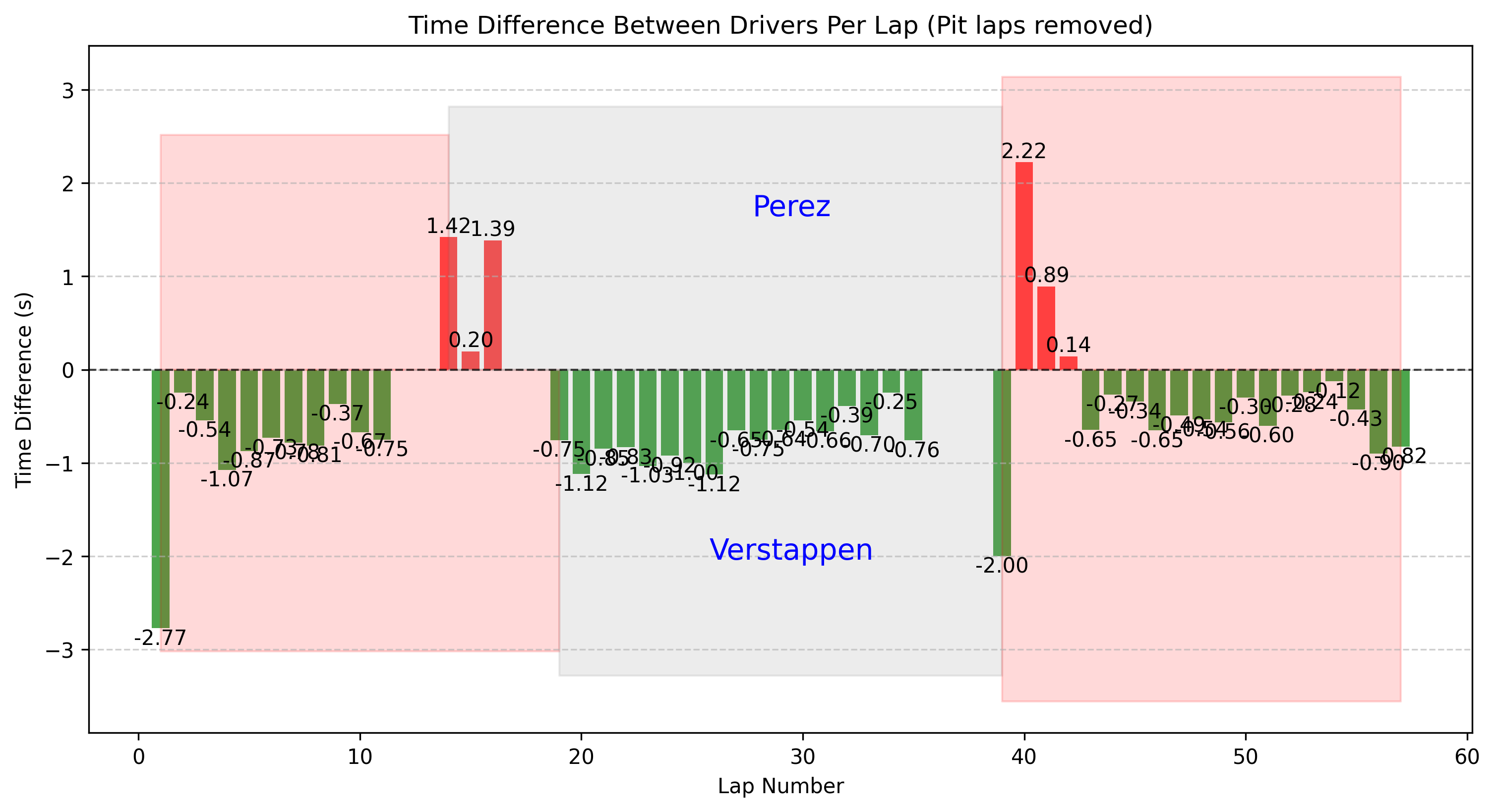 Analyzing the lap times reveals a consistent delta between Verstappen and Perez across the race. The laps where Perez outperformed Verstappen were primarily around the pit windows, as is common when one driver is on fresher tires while the other remains on worn rubber.
Both drivers were on the same strategy: soft-hard-soft. However, Verstappen, leading the race, had the luxury of managing his tires more effectively with free air. This allowed him to extend the life of his soft compound stint, enabling him to push harder when needed in the later stage of the race. In contrast, Perez had to push and bring the fight to the number drivers in front of him, which caused him to wear out his tyre quicker than his team mate.
Analyzing the lap times reveals a consistent delta between Verstappen and Perez across the race. The laps where Perez outperformed Verstappen were primarily around the pit windows, as is common when one driver is on fresher tires while the other remains on worn rubber.
Both drivers were on the same strategy: soft-hard-soft. However, Verstappen, leading the race, had the luxury of managing his tires more effectively with free air. This allowed him to extend the life of his soft compound stint, enabling him to push harder when needed in the later stage of the race. In contrast, Perez had to push and bring the fight to the number drivers in front of him, which caused him to wear out his tyre quicker than his team mate.
Sector Time Breakdown
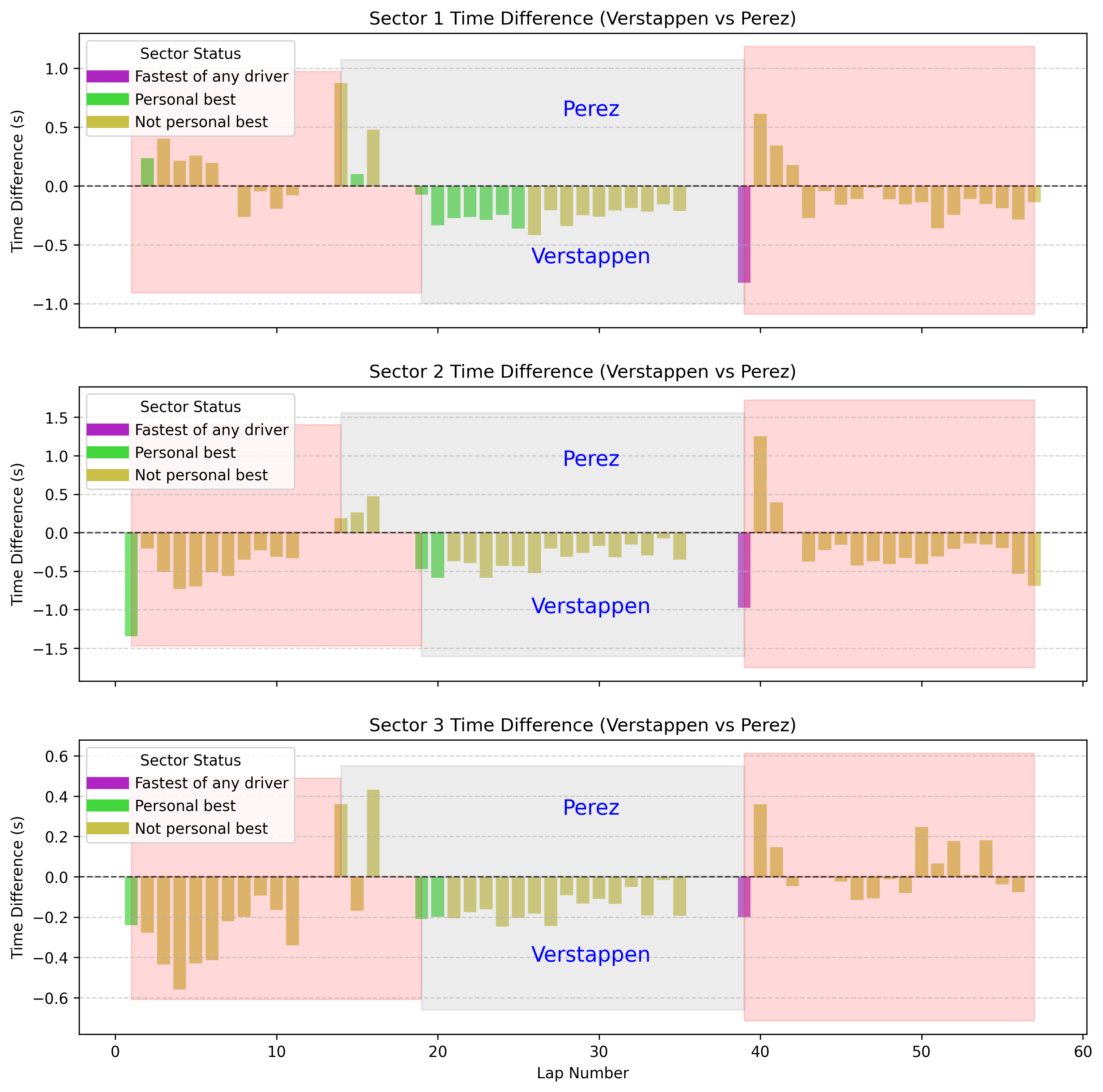 To better understand where Verstappen outperformed Perez, we need to analyze the sector times:
-
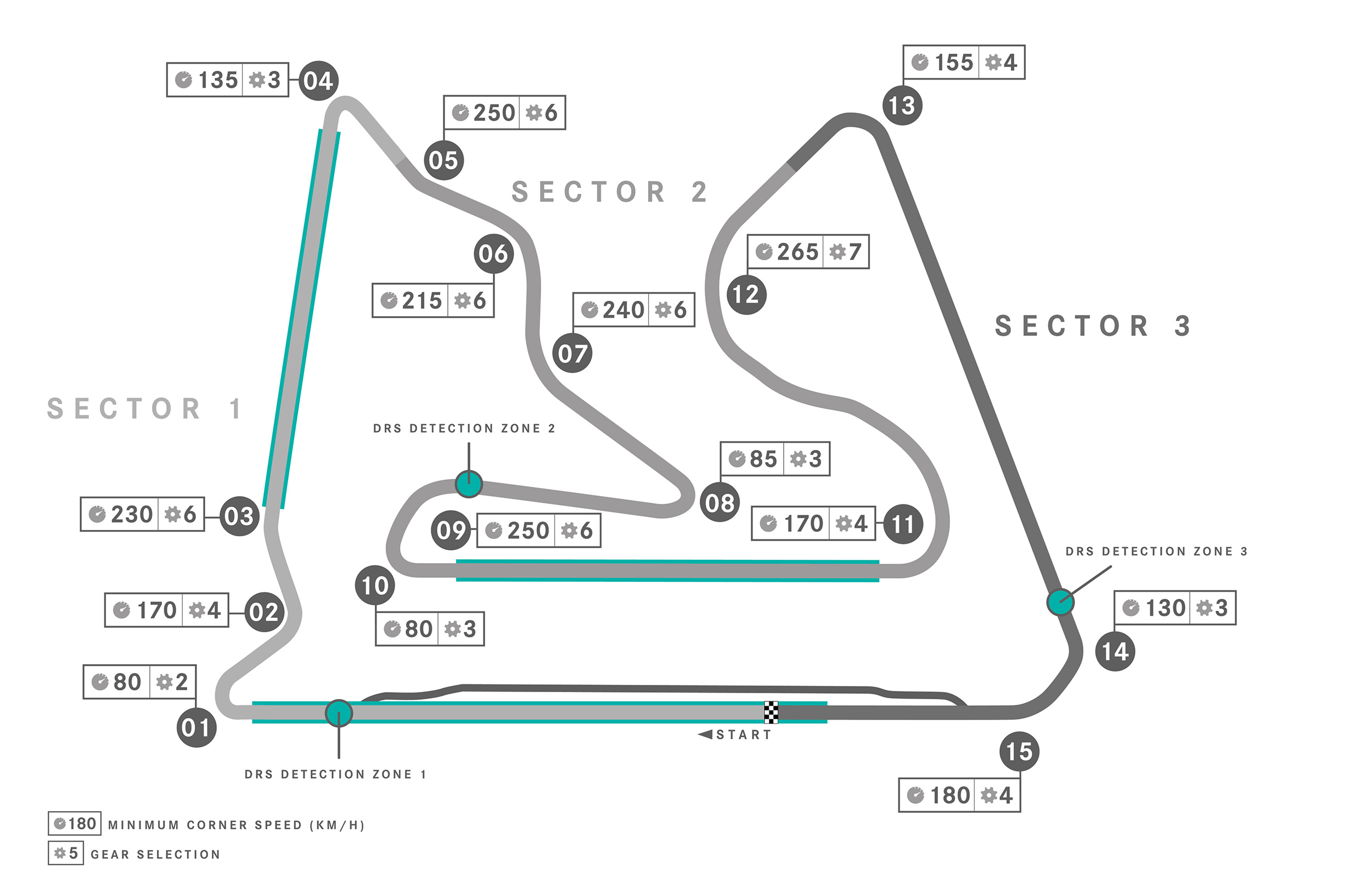
First Stint (Soft Tires, shaded red): In Sector 1, Perez was quicker than Verstappen, possibly a sector he felt confident in and benefiting from slipstreaming early in the race. However, in Sector 2 and Sector 3, Verstappen gained significant time. His superior car control was handy as most of the high and low speed corners were in both these sectors.
-
Second Stint (Hard Tires, shaded grey): After switching to hard tires, Perez’s pace in Sector 1 dropped. Not sure if he was managing his tires early in the stint or the setup didn’t like hard compounds at all. But I would guess he has been told to manage the hard compounds as the second stint is a long one. Verstappen, meanwhile, capitalized on his fresh hard tires, consistently setting personal bests in Sector 1 over the first few laps of this stint. This aggressive approach, coupled with his ability to extract maximum performance from his Red Bull, widened the gap further to Perez. Perhaps he was fed information by his engineer on where his team mate was faster
-
Third Stint (Soft Tires, shaded red): Verstappen’s second pit stop saw him bolt on fresh soft tires, with a lighter fuel load, allowing him to unleash the full potential of the car. He immediately set the fastest lap of the race, showcasing his talent, confidence with the car and his speed.
Throttle Response Analysis
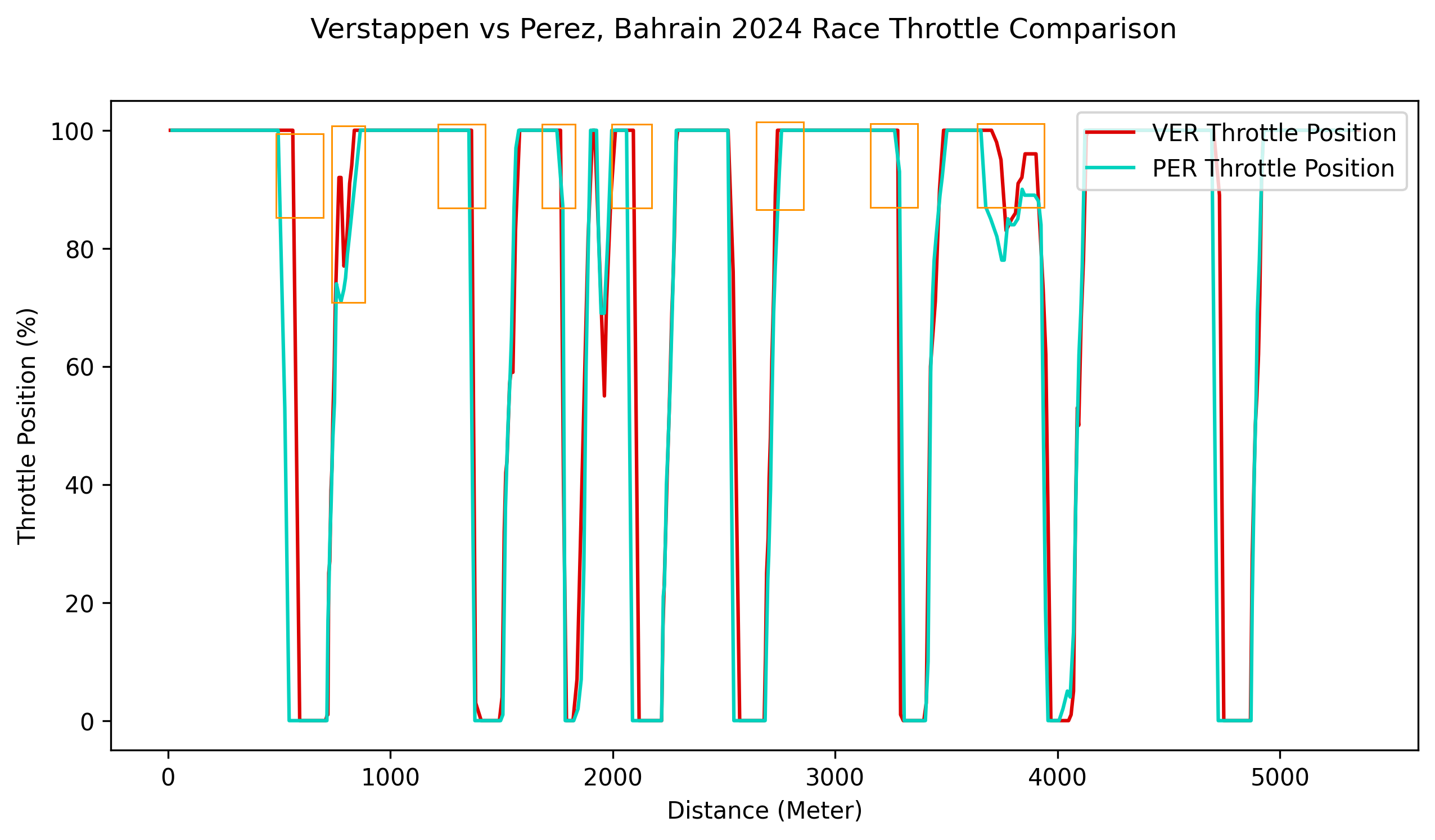 Looking at their throttle responses (fastest lap), it’s evident that Max was a lot more confident with his car, as he is able to brake later into the chicane and accelerate sooner when exiting.
Examining throttle response data highlights a clear difference in driving styles and car confidence between the two drivers:
-
Braking Later: Verstappen was consistently able to brake later into corners. This indicates greater confidence in the car’s stability under braking and his ability to extract maximum performance.
-
Accelerating Earlier: On exits, Verstappen applied the throttle sooner than Perez, allowing him to carry more speed onto the straights. This trait was especially evident in turn 1, where it was tight and low-speed.
Perez, on the other hand, showed a slightly more cautious approach in his throttle application. This could be attributed to tire management or a difference in car setup that didn’t allow him to push as aggressively as Verstappen when needed. The fastest laps from both drivers came about after their second pitstop, on lap 39 and 40 respectively.
Intermediate Speed Analysis
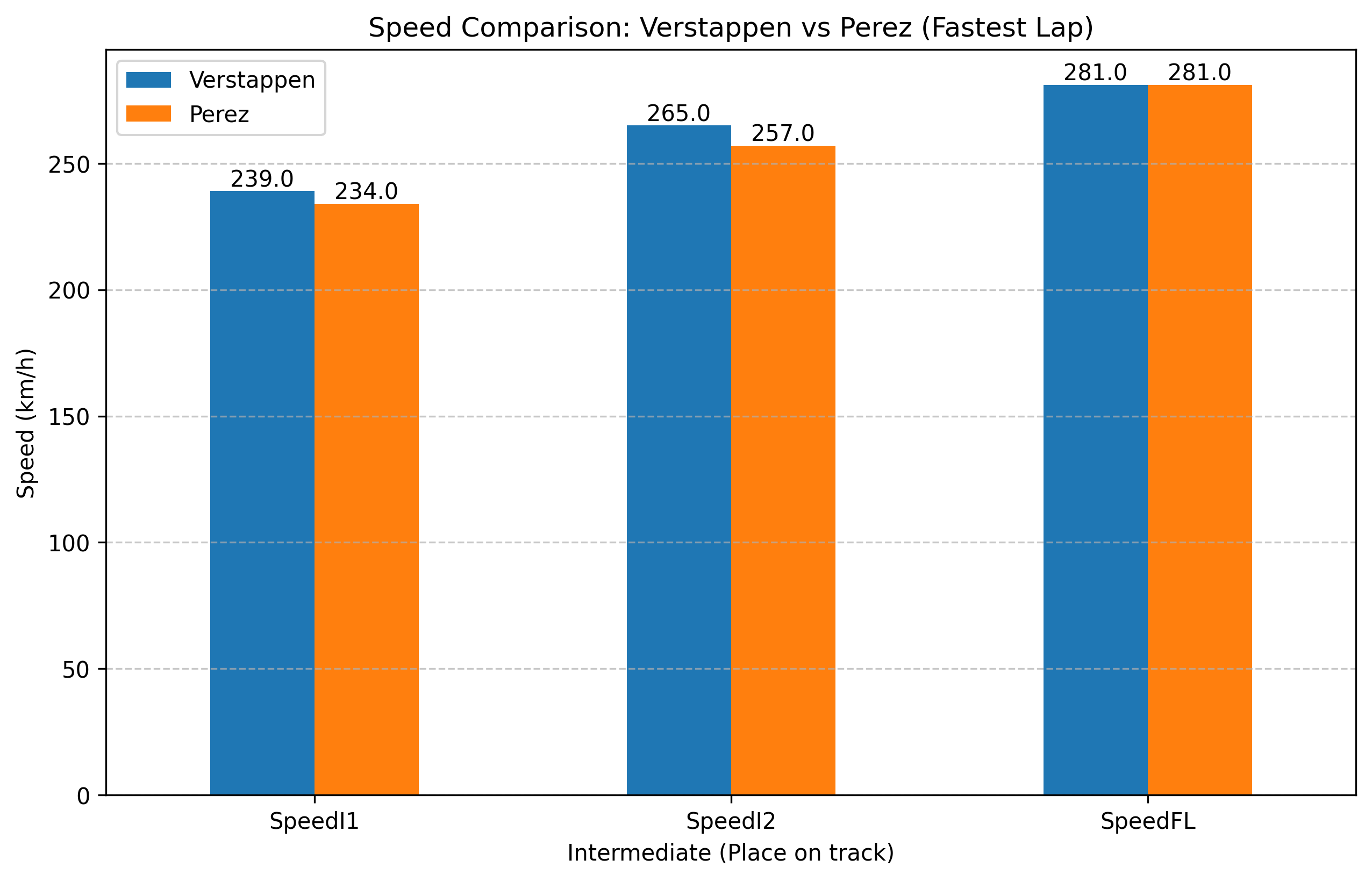 Speed traps are strategically placed across the track, with one in each sector. Intermediate 1 marks the speed trap within Sector 1, while Intermediate 2 corresponds to the speed trap in Sector 2. When analyzing the intermediate speeds, Max edged out Sergio by a small margin in Intermediate 1, showcasing his ability to carry speed early in the lap. However, the gap widened significantly in Intermediate 2, where Verstappen was a notable 8 km/h quicker than Perez. While the precise location of the speed trap is not publicly available, it’s clear that performance in the preceding corners plays a critical role. Sector 2 had a series of high speed corners one after another. A strong exit from these corners allows drivers to maintain momentum and achieve higher speeds at the speed trap, amplifying the advantage of optimal car control and setup. Verstappen’s superior ability to extract performance from his car in these crucial sections is evident from this analysis. Their top speed on the finishing line could indicate that their downforce setup is very similar to each other.
| Driver/Metric | Intermediate 1 (kph) | Intermediate 2 (kph) | Finish Line (kph) |
|---|---|---|---|
| Fastest Recorded | 241 (ALO) | 272 (PIA) | 293 (RUS) |
| Verstappen | 239 | 265 | 281 |
| Perez | 234 | 257 | 281 |
Conclusion
In Bahrain, Verstappen once again demonstrated why he’s a three-time world champion. His ability to manage tires, push the limits of the car, and consistently extract maximum performance made the difference. While Perez showed promise with strong overtakes and steady improvement throughout the race, the data highlights that Verstappen’s confidence in the car and precision in braking and acceleration gave him the edge. As the season progresses, it will be fascinating to see if Perez can close the gap or if Verstappen will continue to dominate. One thing is clear: Red Bull has started 2024 with a statement.
Data Sources and Methodology
All Formula 1 data points were obtained using the FastF1 API, an open-source Python library for processing Formula 1 telemetry and timing data. Data analysis and visualizations were performed using Python, leveraging:
- Pandas for data manipulation and cleaning.
- Matplotlib and Seaborn (sns) for creating detailed visualizations.