Race 2 - Saudi Arabia 2024
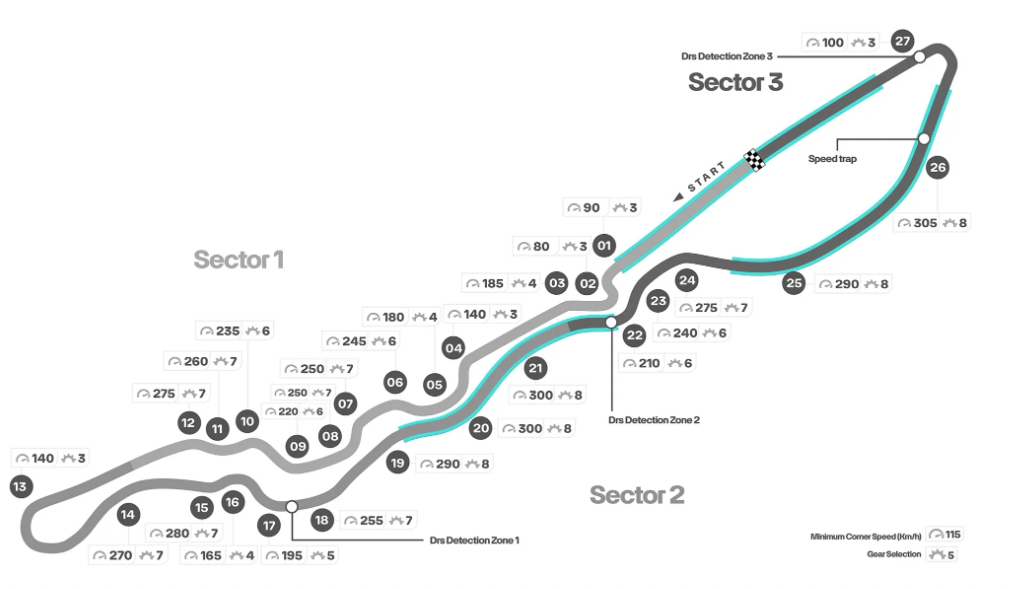
The second race of the season took place in Saudi Arabia, featuring a circuit with an impressive 27 turns—the most of any track on the calendar.
In Q3, Max Verstappen once again showcased his dominance, securing pole position with a brilliant lap. Charles Leclerc followed in P2, while Sergio Pérez took P3. Fernando Alonso continued his strong start to the season, securing P4 in his Aston Martin to complete the first two rows of the grid. Lewis Hamilton faced a tougher session, qualifying in P8, nearly a second off Max’s pace, reflecting limited progress for Mercedes compared to last year.
Sergio Pérez’s fans were hoping for a repeat of his success in 2023, but the race brought a familiar result, with Pérez finishing 13 seconds behind his teammate. Meanwhile, young Oliver Bearman impressed on his debut, finishing P7 and scoring his first points. The race wasn’t as kind to Lance Stroll, who clipped the wall and DNFed early in his Aston Martin, triggering a safety car.
Despite the tight regulations governing car design, the differences between teams’ approaches remain striking. These contrasts are further amplified by the strategic use of DRS, which continues to play a pivotal role in shaping modern Formula 1 races.
DRS: Red Bull Vs Ferrari
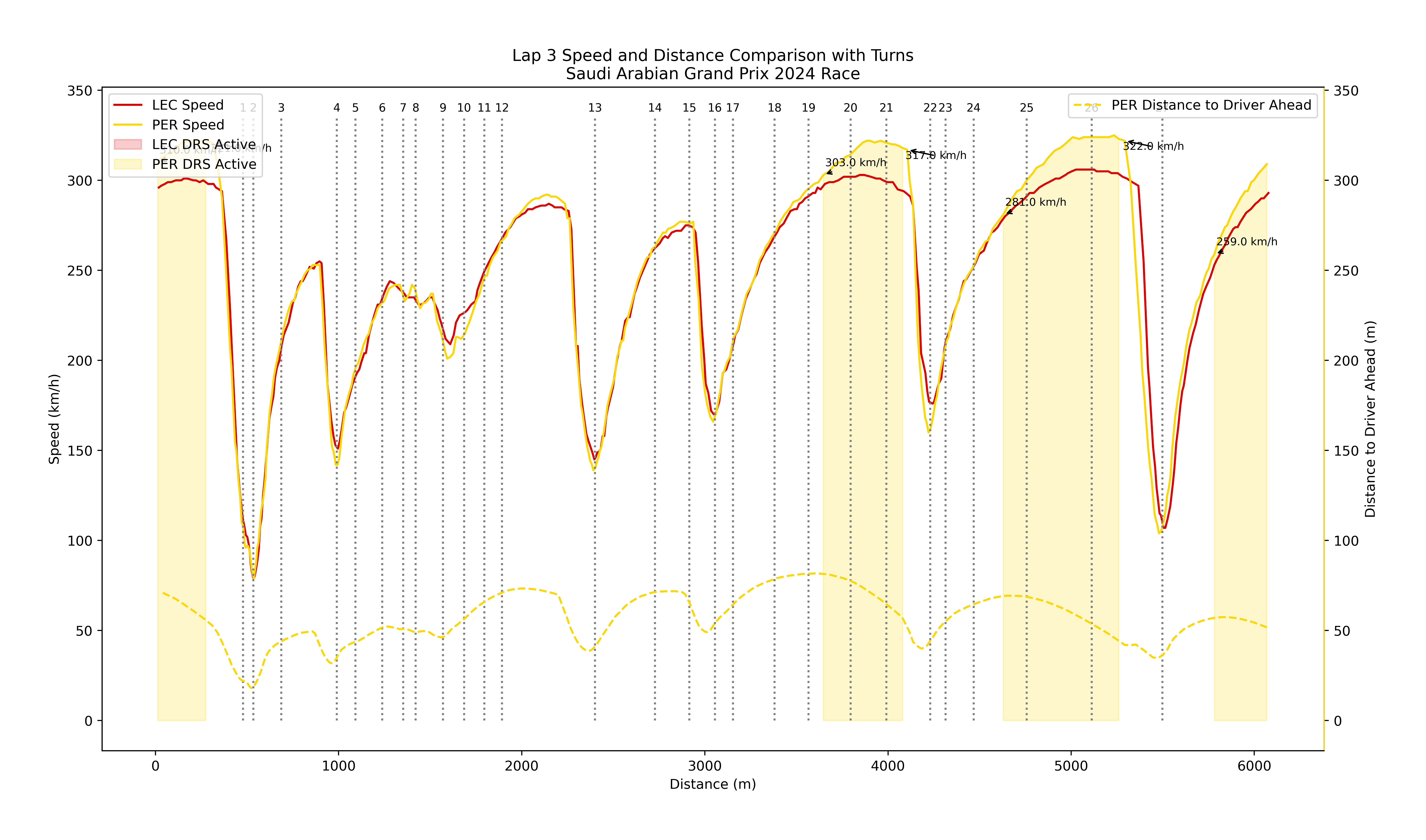 Checo was setting himself up for an overtake on Charles during lap 3. In Sector 1, both drivers were evenly matched, navigating the 12 turns with precision. However, differences started to appear on the long straight between Turns 12 and 13, as well as through the fast sweeping sequence of Turns 14, 15, and 16. High-speed sequences like these demand precision, particularly on a street circuit like Jeddah, where mistakes can result in a DNF. Checo’s smooth speed increase compared to Charles hinted at either greater confidence or a more stable car setup. His familiarity with success in Jeddah, following last year’s strong performance, may have also played a role. Upon reaching the first DRS zone, the speed difference between the two drivers became substantial—a trend that continued in the second DRS zone—highlighting not only the strengths of Red Bull’s car design and setup but also Checo’s growing confidence on the track.
DRS: Mclaren Vs Mercedes
Lewis: They’re killing us in the high-speed.
Bonnington: Yeah copy Lewis, GPS agrees.
Bonnington: Only losses, Lewis, the high-speed and that time straight line with DRS. You are strong turns one, two.
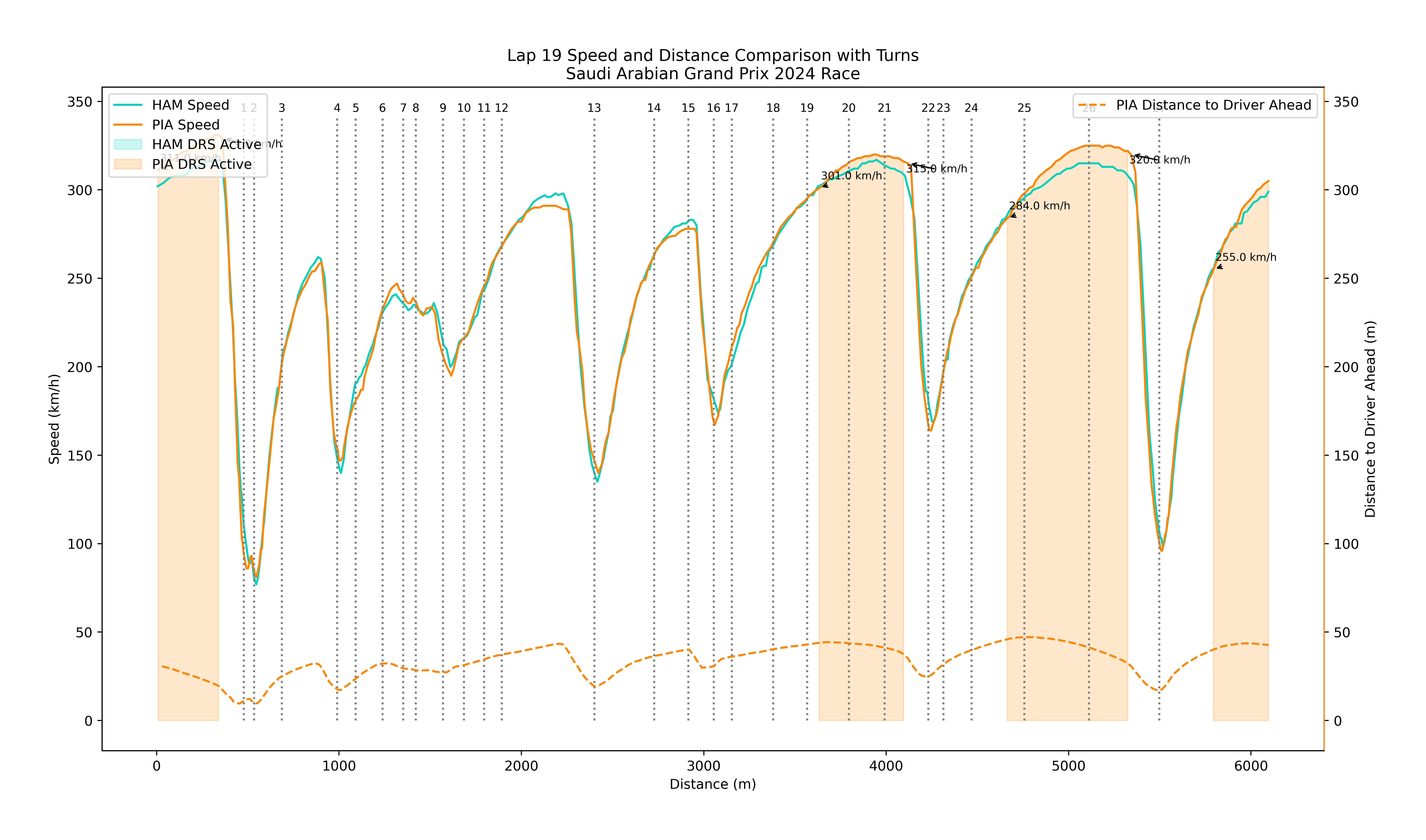
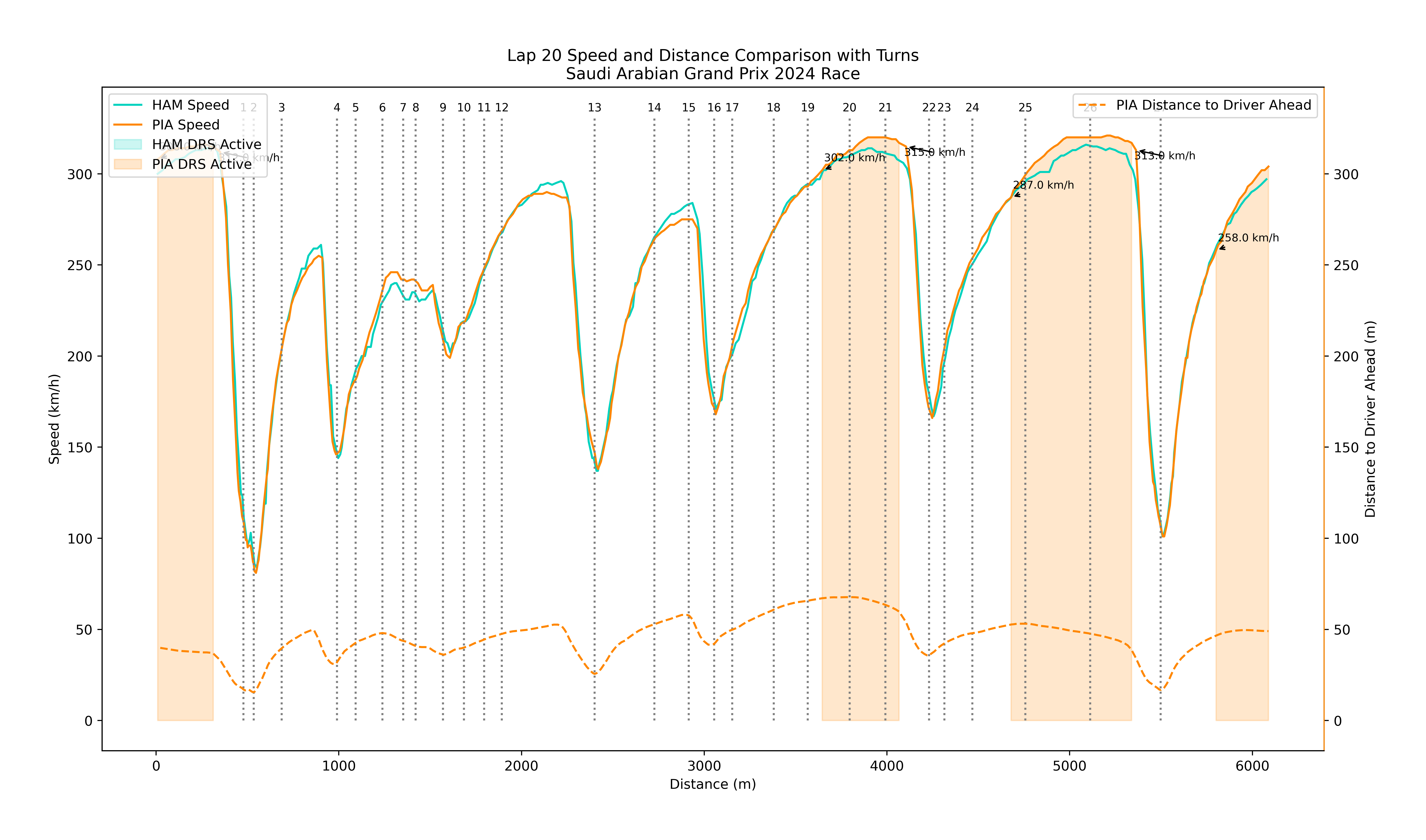
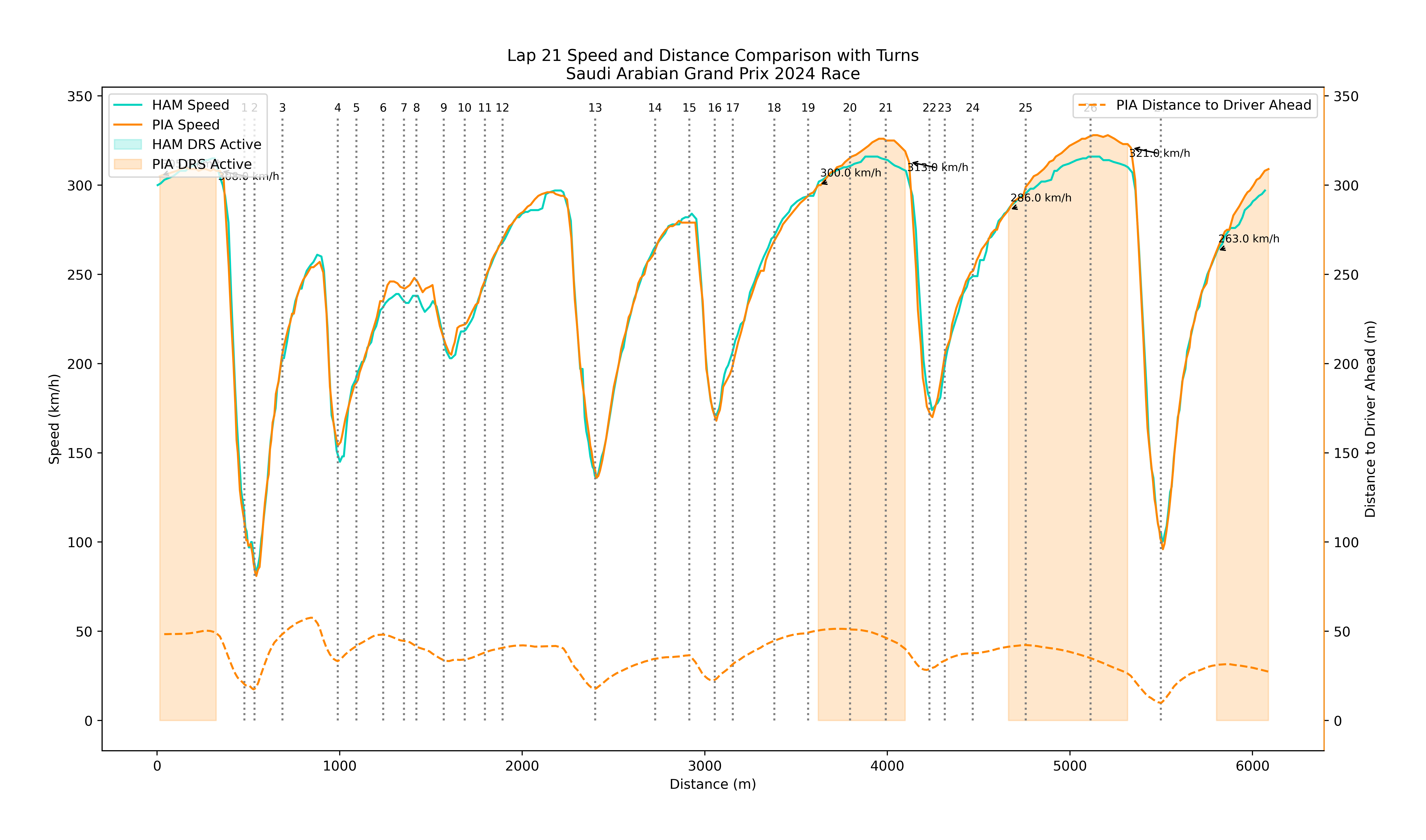
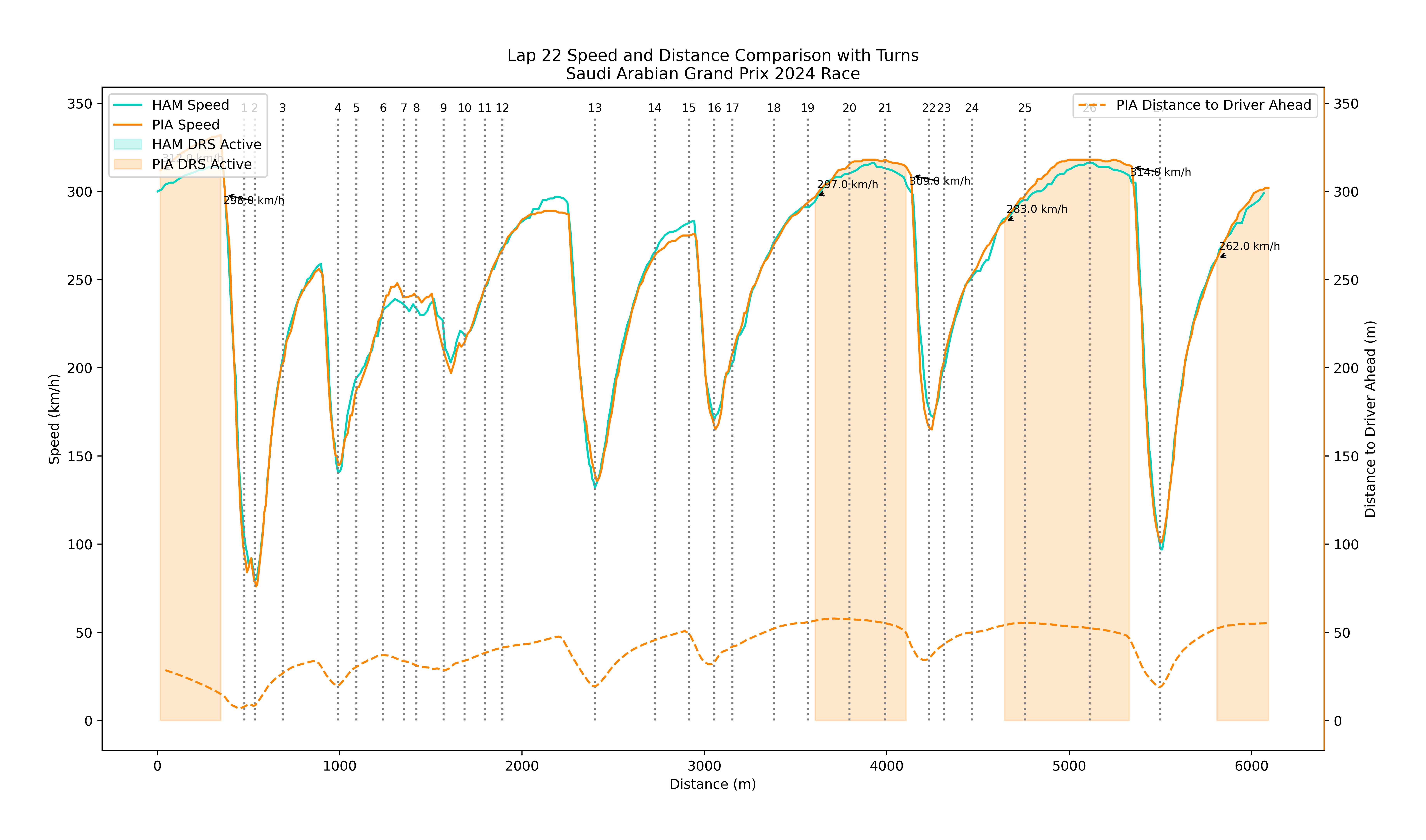
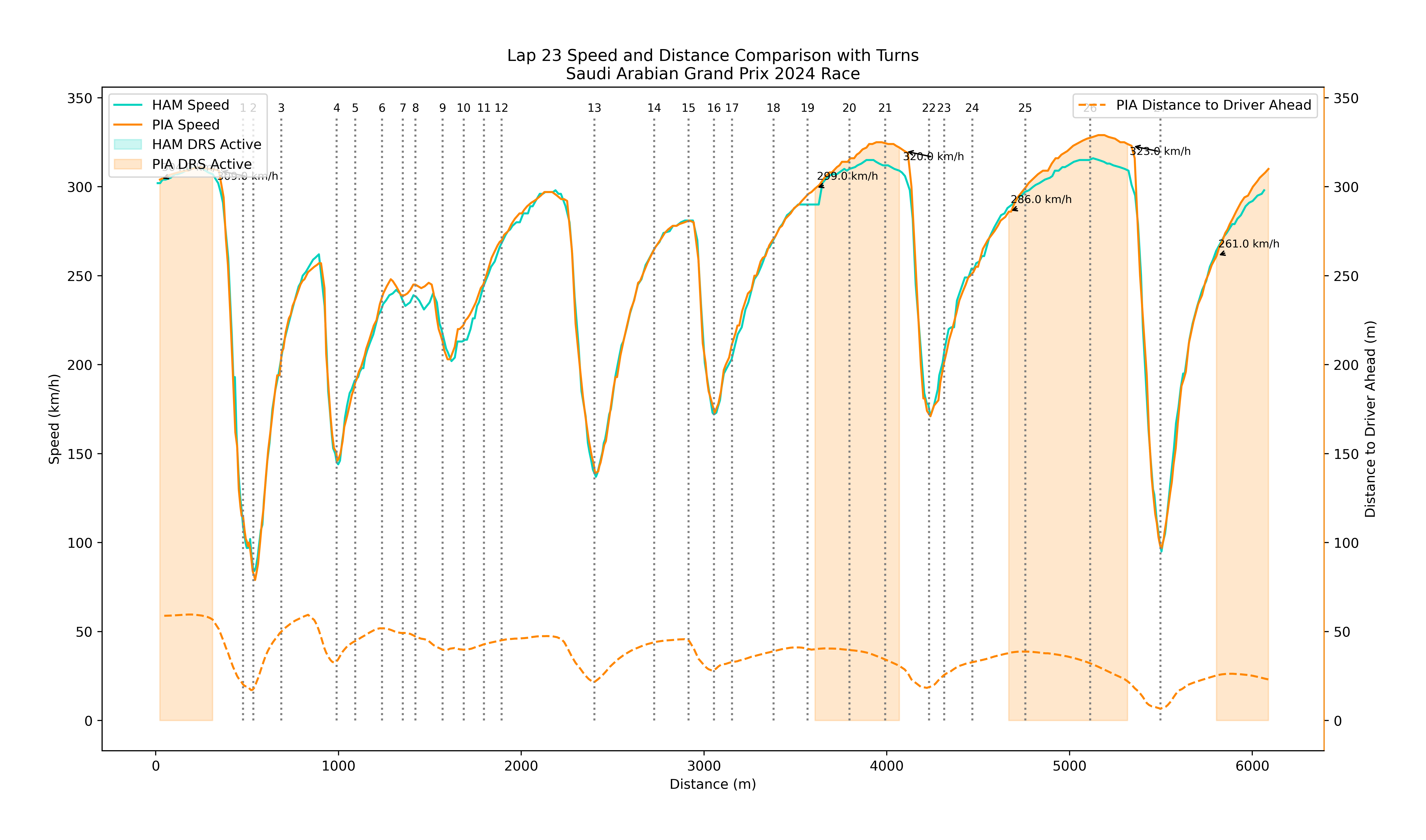
The battle between Lewis Hamilton’s Mercedes and Oscar Piastri’s McLaren was an exciting showcase of skill and craft, keeping fans on the edge of their seats.
From lap 16 to lap 36, Piastri remained glued to Hamilton’s rear, showcasing McLaren’s strength in the high-speed corners of Turns 6 through 9. Sector 1 highlighted McLaren’s aerodynamic efficiency and its ability to generate downforce, but its DRS system didn’t deliver the same overtaking power seen with Red Bull’s. This made it much harder for Piastri to make a move, even when he got close enough.
Hamilton’s experience and race craft shone through during this battle. He positioned his car perfectly to defend against Piastri, forcing him to take suboptimal lines, thus making it difficult for the young driver to find an opening. He has made a few attempts at turn 1 but ran wide and had to give the position back. Piastri, for his part, showed great persistence, keeping the pressure on Hamilton lap after lap without making mistakes. The result was a tense back-and-forth, with Hamilton using his defensive skills and Piastri doing everything he could to try and get past.
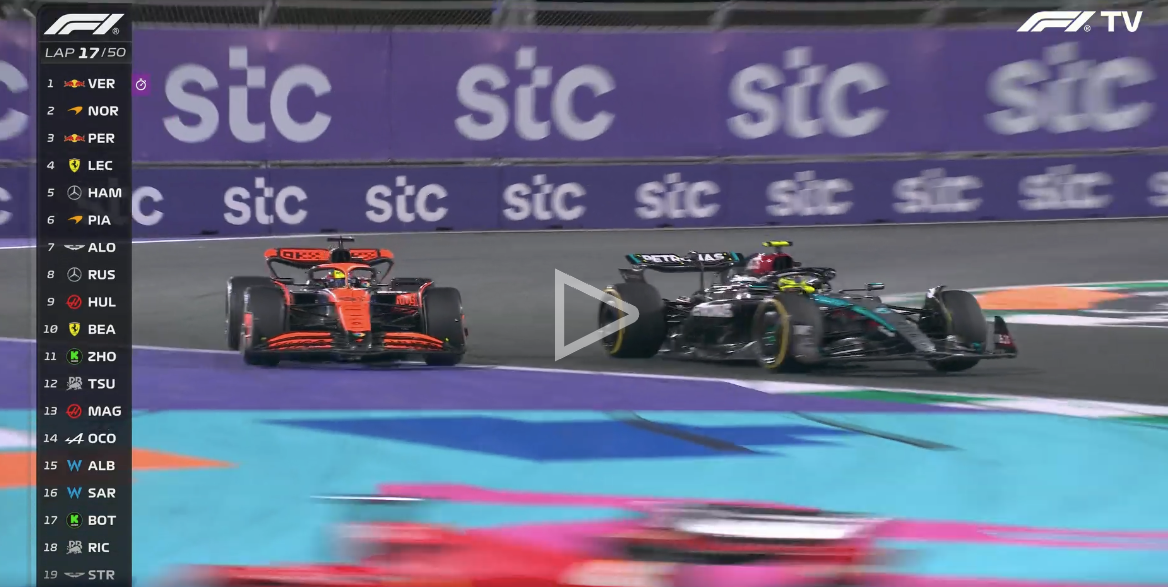 Piastri's overtake attempt on turn 1 (From F1 TV)
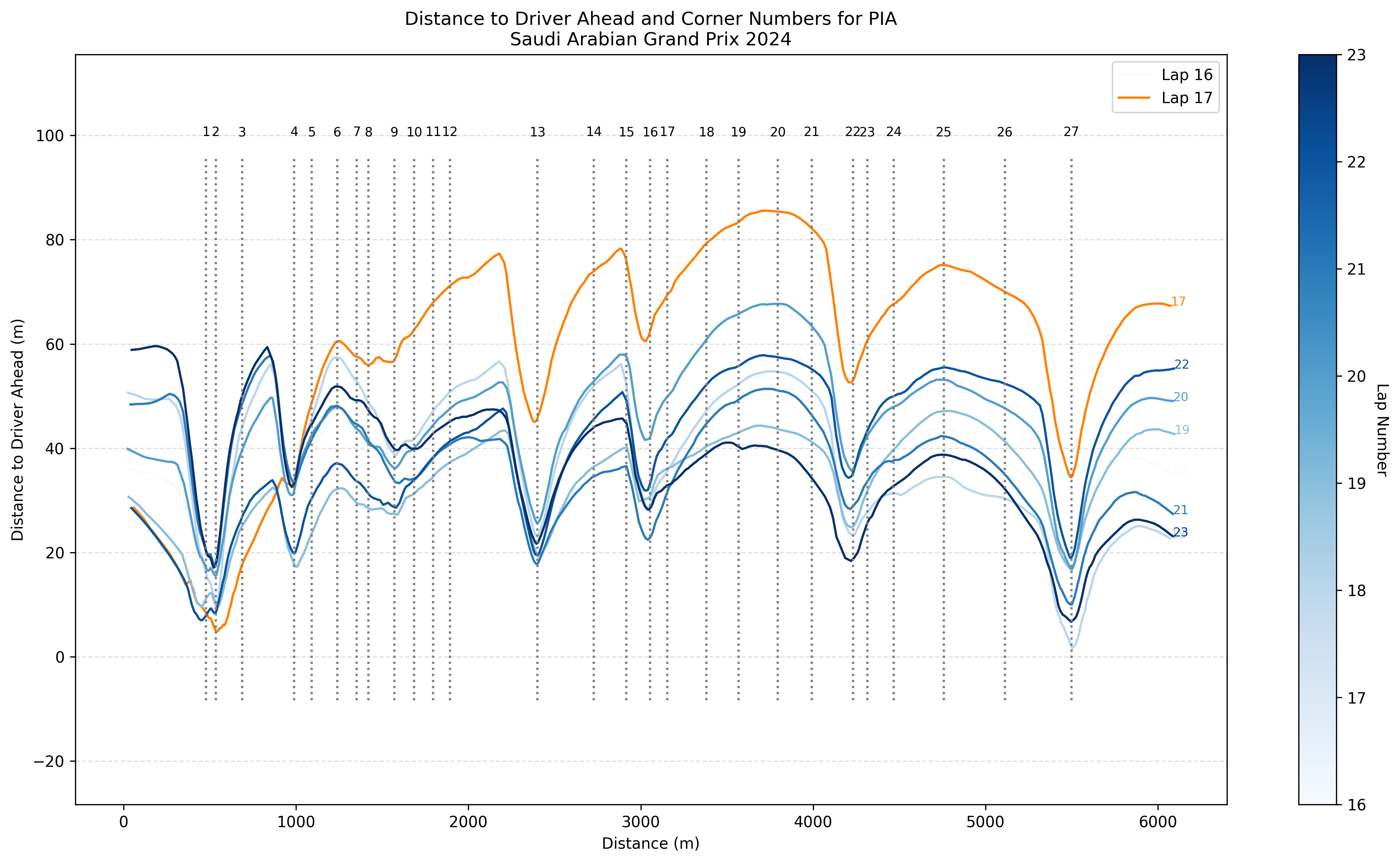 Piastri running wide and had to concede the position back on lap 17
When Hamilton pitted on lap 36, it ended an intense part of the race. Home viewers were treated to a true exhibition of racing skills, as both drivers delivered a masterclass in racecraft. Piastri’s performance reaffirmed his status as one of the sport’s rising stars.
| Driver/Metric | Intermediate 1 (kph) | Intermediate 2 (kph) | Finish Line (kph) |
|---|---|---|---|
| Fastest Recorded | 295 (HAM, Soft, L46) | 332 (OCO,Hard, L28) | 315 (ALB, Hard, L32) |
| Verstappen | - | 315 (Hard, L50) | 292 (Hard, L50) |
| Perez | 286 (Hard, L37) | 303 (Hard, L37) | 295 (Hard, L37) |
Conclusion
This duel wasn’t just about car performance—it was about the skill and determination of two drivers at very different stages of their careers, the old guard versus the next generation talent. It is also a great reminder of what makes Formula 1 exciting: close racing, smart tactics, and drivers pushing each other to the limit.
Data Sources and Methodology
All Formula 1 data points were obtained using the FastF1 API, an open-source Python library for processing Formula 1 telemetry and timing data. Data analysis and visualizations were performed using Python, leveraging:
- Pandas for data manipulation and cleaning.
- Matplotlib and Seaborn (sns) for creating detailed visualizations.